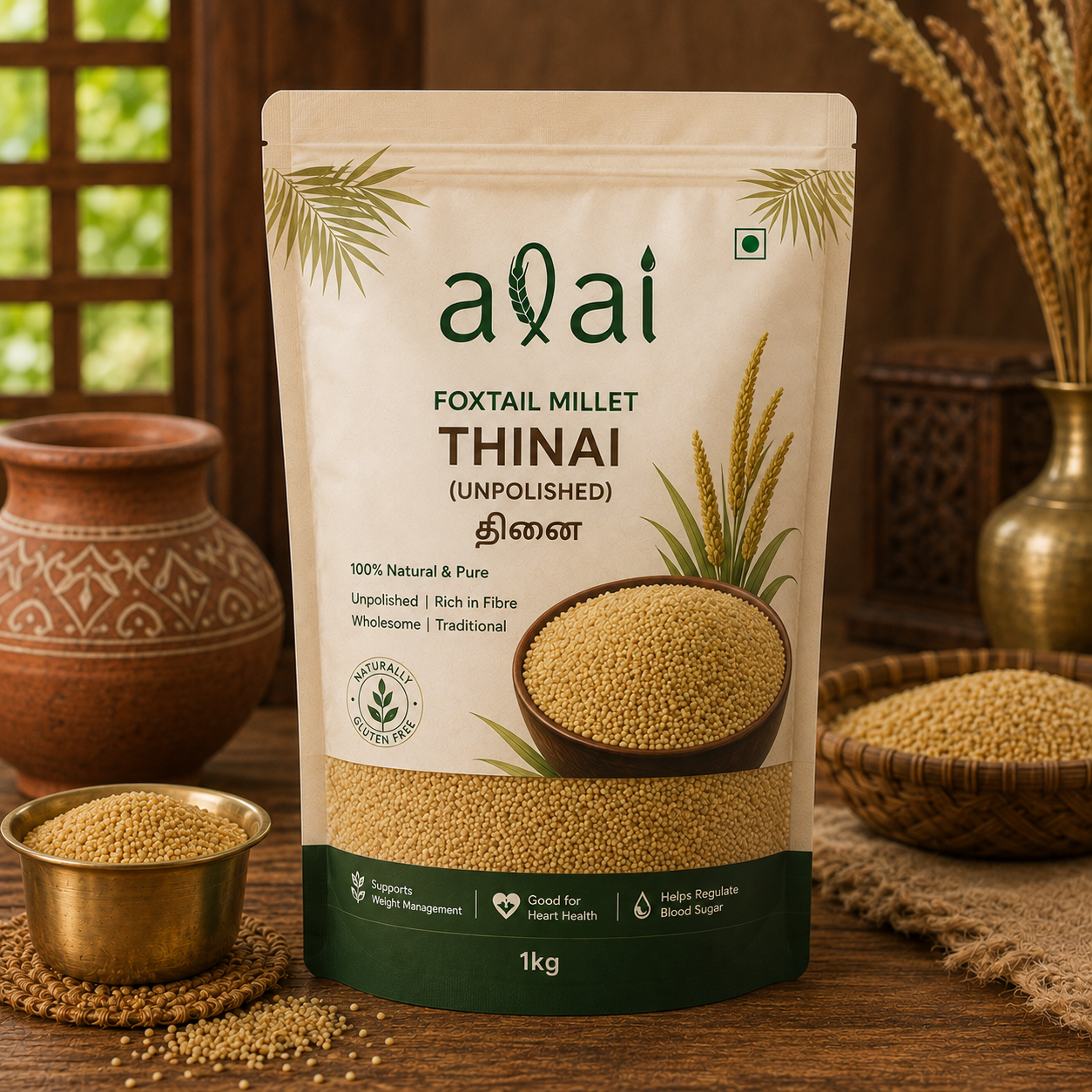
Firm grain, and why that matters
Millets differ more than people expect. Barnyard collapses soft and rice-like. Thinai doesn't — it stays firm and separate, closer to a good bhat or couscous than to steamed rice.
That makes it the better choice wherever you want distinct grains: upma, pongal, lemon rice, pulao, biryani, tamarind rice. It works as plain rice too, but that firmness is what it's actually good at, so cook to its strength.
What unpolished means
Polishing scrapes the bran layer off the grain to make it whiter, quicker to cook and longer-lasting on a shelf. It also takes most of the fibre with it.
Much of the millet sold in India is polished, sometimes heavily. Ours isn't — which is why the grain is a warm, uneven gold rather than a uniform pale white, and why it needs a soak and a few extra minutes in the pot.
Why customers choose ALAI
- Unpolished, bran intact. No polishing to whiten the grain.
- Cleaned and hand-sorted. Destoned and sieved before packing.
- Sourced from Tamil Nadu growers. Thinai grown where it has always been grown.
- Packed in small lots. Unpolished grain keeps best fresh.
- No additives, no polish, no colour. Just the grain.
How to cook it
Rinse and soak. Rinse twice, soak 30 minutes. Thinai is firmer than barnyard, so the soak matters more here — skip it and you get a hard centre.
Pressure cooker — 1 cup thinai to 2 cups water, 2 whistles, natural release. Grains stay separate.
Open pot — 1 cup to 2.5 cups water, simmer 15–20 minutes, rest covered 5 minutes, fluff with a fork.
For upma — dry roast the millet for 2 minutes before adding it to the tempering, then 1 cup to 2.5 cups hot water. The roast is what stops it going lumpy.
For pongal — 1 cup thinai to 3 cups water with the dal. Softer is right here.
For idli or dosai — replace the rice in your usual batter with thinai at the same ratio to urad dal. Ferment as normal. The dosai comes out crisper than an all-rice one.
What to make with it
Thinai pongal · Thinai upma · Lemon millet · Curd millet · Thinai pulao and biryani · Puliyodarai · Thinai idli and dosai · Thinai kozhukattai · Thinai payasam
For festivals: thinai maavu payasam and thinai kozhukattai are the traditional preparations, and this is the grain they were written for.
Product details
| Brand | ALAI |
| Grain | Foxtail millet (Setaria italica) |
| Also known as | Thinai, thinai arisi, kangni, korra, navane |
| Processing | Dehusked, unpolished, machine-cleaned |
| Ingredients | 100% foxtail millet. Nothing added. |
| Available in | 500 g / 1 kg |
| Packaging | Food-grade sealed pouch |
| Shelf life | 12 months from packing |
| Storage | Airtight container in a cool, dry place |
| FSSAI Lic. No. | 22426306000092 |
A note on colour and shelf life
Unpolished thinai is golden and varies between batches — that's the bran, not a defect. Because the bran carries natural oils, it keeps for less time than polished grain. Six months in an airtight jar is realistic. If you buy 5 kg, decant into smaller jars rather than opening one pack over and over.