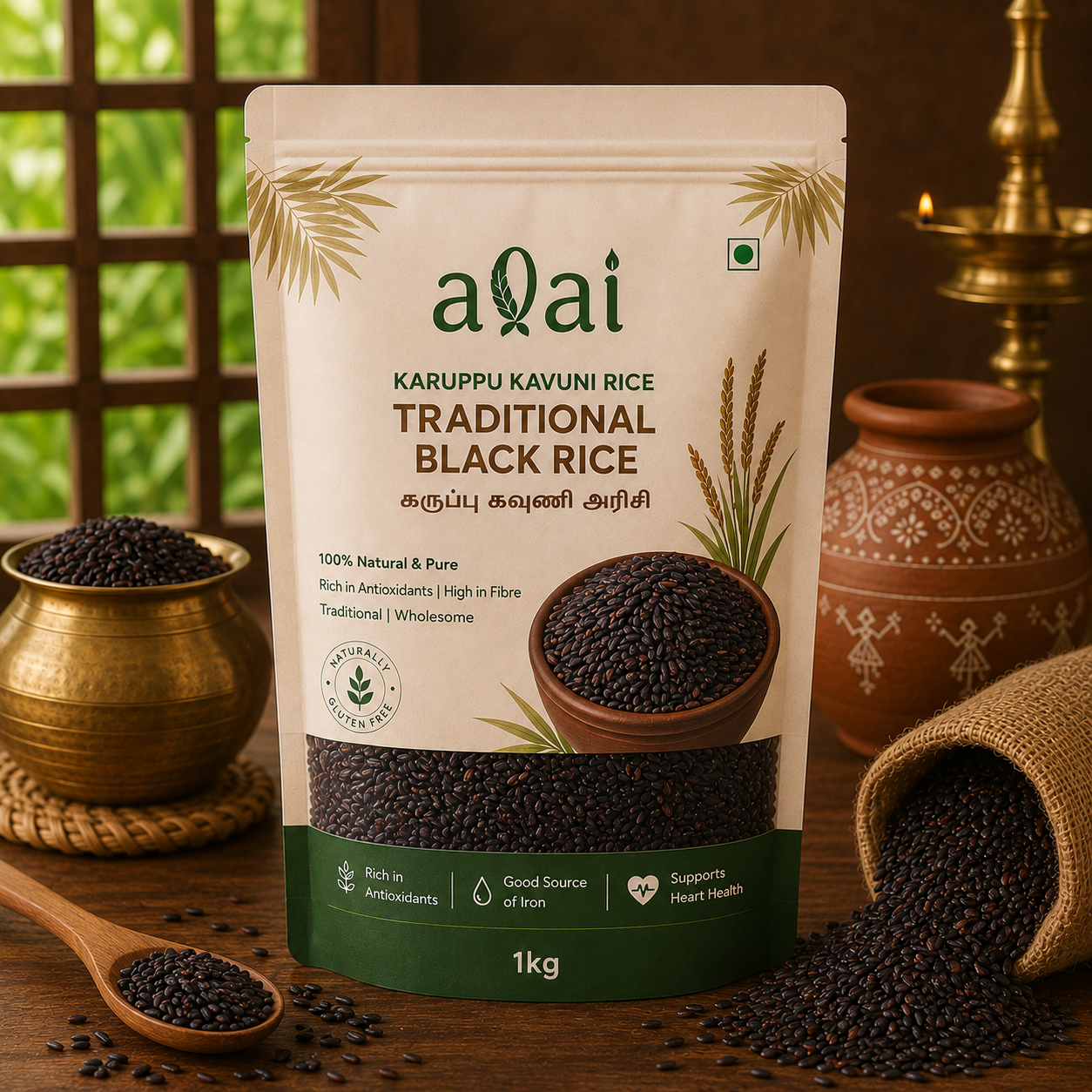
A rice with a reputation
Kavuni was never an everyday rice. It was the one brought out for weddings, festivals and guests — partly because it yields poorly and takes long in the field, partly because it's genuinely special.
In Chettinad it survived as a dessert: kavuni arisi, cooked down with jaggery and coconut, served in small portions at the end of a meal. That dish is the reason the variety is still around.
What it's like to cook and eat
The dry grain is near-black. Cooked, it releases its colour and turns a deep purple that stains the water and anything cooked with it. That's the anthocyanin pigment in the bran — the same thing that makes it black in the first place.
The texture is firm and chewy, more so than mappillai samba. The flavour is nutty with a faint sweetness. It doesn't behave like white rice at all, so don't try to use it as one. Use it where its character is the point.
What unpolished means
Polishing scrapes the bran off to make grain whiter, faster-cooking and longer-keeping. With kavuni, polishing would strip away the black entirely — the colour lives in the bran.
Ours is unpolished. What you see is the whole grain.
Why customers choose ALAI
- Unpolished, bran intact. With kavuni this isn't a preference, it's what makes it kavuni.
- A traditional native variety. Not an imported black rice, not a blend.
- Cleaned and hand-sorted. Destoned and sieved before packing.
- Sourced from Tamil Nadu growers still cultivating native paddy.
- Nothing added. No polish, no colour, no coating.
How to cook it
Kavuni is the most demanding rice on our shelf. It needs a long soak and plenty of water. Plan ahead.
Rinse and soak. Rinse twice, then soak for at least 6 hours. Overnight is what we'd actually recommend. The water will turn deep purple — that's normal, and you can cook it in that same water.
Pressure cooker — 1 cup rice to 3.5 cups water, 6 to 7 whistles, natural release.
Open pot — 1 cup to 4 cups water, boil 40–50 minutes until the grain is tender but still has bite.
For kavuni arisi (the Chettinad sweet) — soak overnight, pressure cook soft, then simmer with grated jaggery until it thickens. Finish with grated coconut and a little ghee. Serve warm in small portions. This is the dish the rice is famous for and the best introduction to it.
For kanji — 1 cup to 6 cups water, simmered until it breaks down.
As plain rice — it works, but it's assertive. Pair it with something equally strong rather than a mild dal.
A note on the colour: kavuni stains. It will tint your hands, your pot and anything you cook alongside it. That's the pigment doing what it does — nothing has gone wrong.
What to make with it
Kavuni arisi (Chettinad jaggery sweet) · Kavuni kanji · Kavuni payasam · Plain rice with a strong kuzhambu · Kavuni pongal · Kavuni salad, served cold with vegetables and lemon
Product details
| Brand | ALAI |
| Variety | Karuppu kavuni (traditional Tamil black rice) |
| Also known as | Kavuni arisi, karupu kavuni, black kavuni |
| Processing | Dehusked, unpolished |
| Ingredients | 100% karuppu kavuni rice. Nothing added. |
| Available in | 500 g / 1 kg |
| Packaging | Food-grade sealed pouch |
| Shelf life | 12 months from packing |
| Storage | Airtight container in a cool, dry place |
| FSSAI Lic. No. | 22426306000092 |
A note on colour and shelf life
Shade varies between batches and harvests — some lots run closer to deep purple-brown than true black. That's normal in a native variety. The bran carries natural oils, so unpolished rice keeps for less time than polished. Six months in an airtight container is realistic.