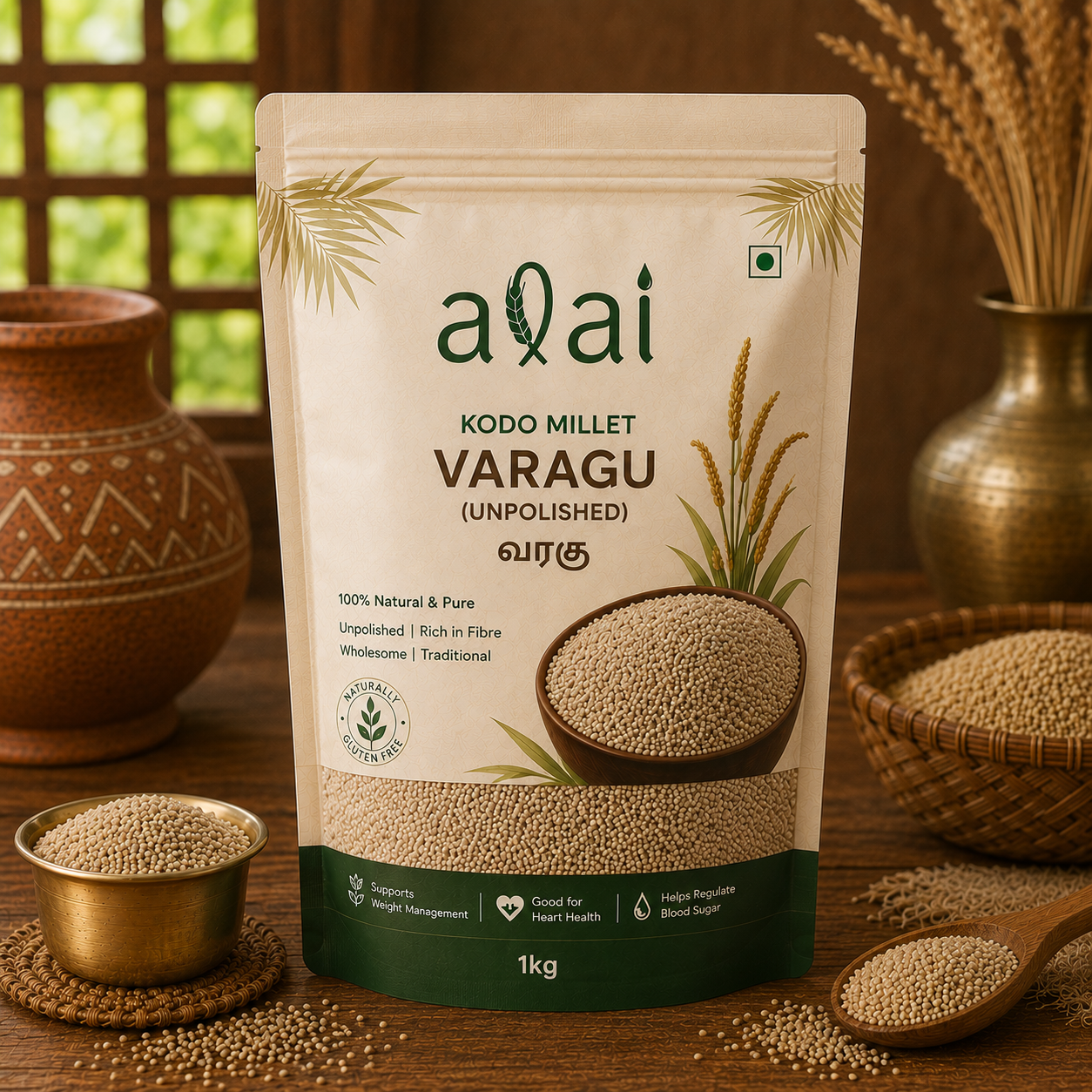
A grain with body
Varagu cooks up firm and slightly chewy, with a mild earthy flavour that stands up to spice rather than disappearing under it. That's why it works so well in biryani, pulao and anything with a strong masala — the grain still tastes of something at the end.
It's also more filling than the other small millets, glass for glass. Cook a cup of varagu expecting a rice-sized appetite and you'll usually have some left over.
What unpolished means
Polishing strips the bran layer off the grain to make it whiter, faster-cooking and longer-lasting on a shelf. Most of the fibre goes with it.
Ours isn't polished, which is why the grain is an uneven grey-beige rather than a uniform white, and why it needs a proper soak and more water than rice.
Why customers choose ALAI
- Unpolished, bran intact. No polishing to whiten the grain.
- Cleaned and hand-sorted. Destoned and sieved carefully before packing.
- Sourced from Tamil Nadu growers. Varagu grown where it's always been grown.
- Packed in small lots. Unpolished grain is best fresh.
- No additives, no polish, no colour. Just the grain.
How to cook it
Varagu needs more soaking and more water than the other millets. This is the single thing that decides whether you like it.
Rinse and soak. Rinse three times, then soak for at least 45 minutes — an hour is better. Undersoaked varagu is hard in the middle and that's what puts people off it.
Pressure cooker — 1 cup varagu to 3 cups water, 3 whistles, natural release.
Open pot — 1 cup to 3.5 cups water, simmer 20–25 minutes, rest covered 10 minutes, then fluff.
For biryani or pulao — 1 cup to 2.5 cups liquid, since the masala and vegetables add moisture. Soak the full hour.
For curd rice — cook it soft with 1 cup to 4 cups water. Varagu curd rice is one of the best things you can do with this grain.
For idli or dosai — swap varagu for the rice in your usual batter at the same ratio to urad dal. Ferment as normal.
What to make with it
Varagu biryani · Varagu pulao · Curd varagu · Varagu upma · Lemon varagu · Puliyodarai · Varagu idli and dosai · Varagu adai · Varagu payasam
Product details
| Brand | ALAI |
| Grain | Kodo millet (Paspalum scrobiculatum) |
| Also known as | Varagu, varagu arisi, kodra, kodon, arikelu, harka |
| Processing | Dehusked, unpolished, machine-cleaned and destoned |
| Ingredients | 100% kodo millet. Nothing added. |
| Available in | 500 g / 1 kg |
| Packaging | Food-grade sealed pouch |
| Shelf life | 12 months from packing |
| Storage | Airtight container in a cool, dry place |
| FSSAI Lic. No. | 22426306000092 |
A note on colour and shelf life
Unpolished varagu is grey-beige and varies batch to batch — that's the bran. Because the bran carries natural oils, unpolished grain keeps for less time than polished. Six months in an airtight jar is realistic. Decant a 5 kg pack into smaller jars rather than opening one repeatedly.