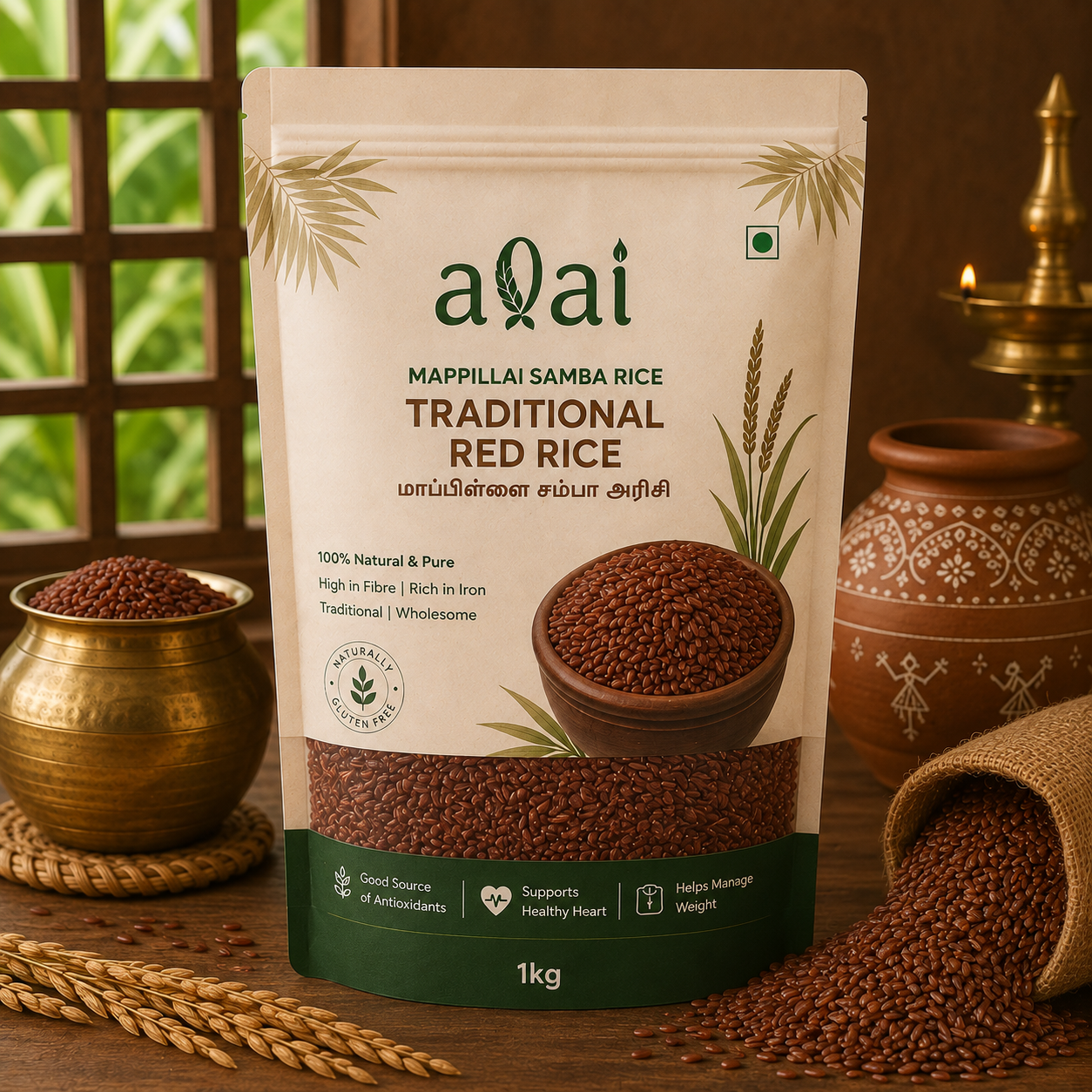
A rice that nearly disappeared
Tamil Nadu once grew hundreds of native rice varieties. Most were pushed out over the last few decades by high-yield hybrids that grow faster, mill whiter and sell cheaper.
Mappillai samba survived because farmers kept planting it and families kept asking for it. It takes longer in the field, yields less per acre, and can't be polished into anything resembling supermarket rice. It stayed because it was worth keeping.
What it's actually like to eat
Firm and chewy, with a distinct nutty flavour and a deep reddish-brown colour that comes from the bran. It doesn't go soft and fluffy the way polished white rice does, and it isn't trying to.
It's more filling than white rice — most people find they eat less of it and stay satisfied longer. Served with a strong kuzhambu or a good sambar, it holds its own instead of disappearing.
What unpolished means
Polishing scrapes the reddish bran layer off the grain to make it white, quicker-cooking and longer-lasting. All the colour and most of the fibre go with it.
Ours isn't polished. That's why the grain is red, why it takes longer to cook, and why it doesn't look like the rice in most kitchens.
Why customers choose ALAI
- Unpolished, bran intact. No polishing to lighten the grain.
- A traditional native variety. Not a hybrid, not a blend.
- Cleaned and hand-sorted. Destoned and sieved before packing.
- Sourced from Tamil Nadu growers who still cultivate native paddy.
- Nothing added. No polish, no colour, no coating.
How to cook it
Mappillai samba needs more soaking and more water than white rice. This is the whole game — get the soak right and it's excellent, skip it and it's hard.
Rinse and soak. Rinse twice, then soak for at least 2 hours. Overnight is better and makes a noticeable difference.
Pressure cooker — 1 cup rice to 3.5 cups water, 5 to 6 whistles, natural release.
Open pot — 1 cup to 4 cups water, boil 35–40 minutes until tender, then drain the excess. This is how it was traditionally cooked and it gives the best texture.
For kanji — 1 cup to 6 cups water, simmered until it breaks down. Mappillai samba kanji with a little buttermilk and salt is the classic preparation and still the best one.
For idli or dosai — replace the rice in your usual batter at the same ratio to urad dal. Soak the samba longer than you would white rice. The dosai comes out darker and nuttier.
Save the drained water. It's the traditional rice kanji water, drunk with salt and buttermilk. Don't throw it away.
What to make with it
Mappillai samba sadam with kuzhambu · Rice kanji · Puliyodarai · Curd rice · Idli and dosai · Sweet pongal · Mappillai samba adai · Rice flour for kozhukattai
Product details
| Brand | ALAI |
| Variety | Mappillai samba (traditional Tamil red rice) |
| Also known as | Mapillai samba, maapillai samba, bridegroom's rice |
| Processing | Dehusked, unpolished |
| Ingredients | 100% mappillai samba rice. Nothing added. |
| Available in | 500 g / 1 kg |
| Packaging | Food-grade sealed pouch |
| Shelf life | 12 months from packing |
| Storage | Airtight container in a cool, dry place |
| FSSAI Lic. No. | 22426306000092 |
A note on colour and shelf life
The red comes from the bran and varies between batches and harvests — that's the grain, not a defect. Because the bran carries natural oils, unpolished rice keeps for less time than polished white rice. Six months in an airtight container is realistic. Decant a 10 kg sack into smaller jars rather than opening it repeatedly.